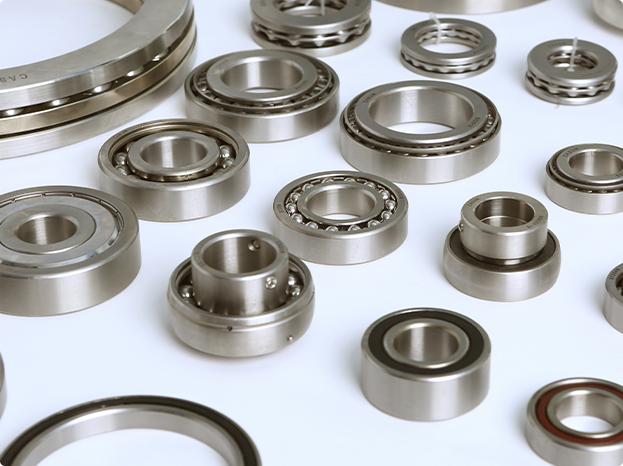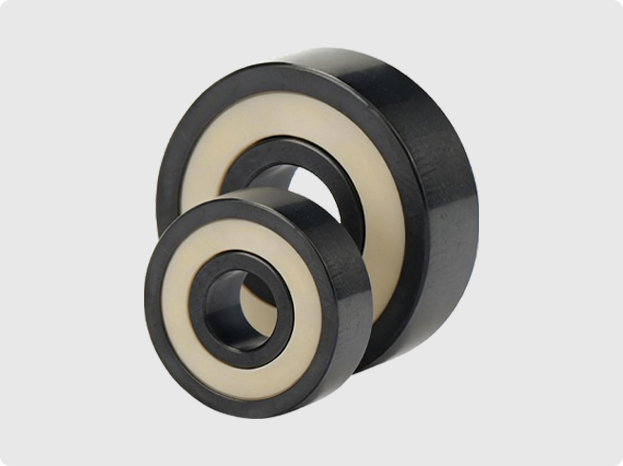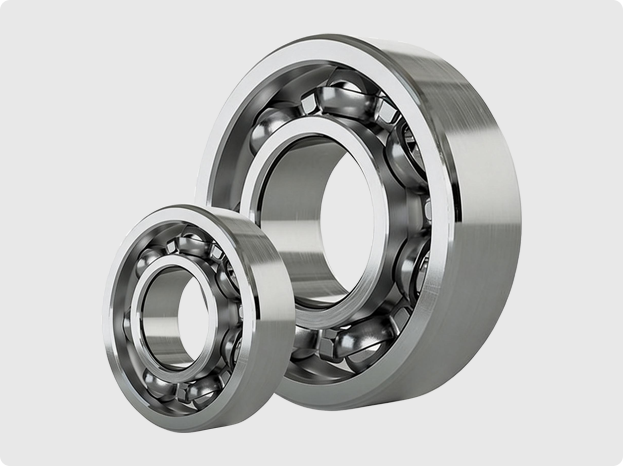

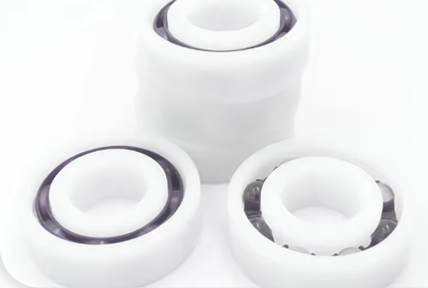
Plastic bearings are a category of lightweight bearings that use engineering plastics or special plastics as the core material (rings, rolling elements, or integral structure). Through material modification and structural optimization, they are adapted to special working conditions such as oil-free lubrication, lightweight design, low noise, and corrosion resistance. They are widely used in food machinery, medical devices, sanitary ware, office equipment, water treatment systems, and other fields. Their core characteristics are as follows:
Lightweight and Low Density
The engineering plastics used (such as PA66, PEEK, PTFE, POM) have a density of only 1.0~1.5 g/cm³, far lower than metal bearings (approximately 7.8 g/cm³). For the same specifications, their weight is only 1/5 to 1/8 that of metal bearings. This lightweight characteristic significantly reduces equipment operating inertia and energy consumption, making them particularly suitable for weight-sensitive applications such as drones, precision instruments, and small transmission components.
Excellent Corrosion Resistance
Plastics are chemically inert materials and do not react with corrosive media such as weak acids, weak alkalis, salt spray, and organic solvents. Their resistance far exceeds that of ordinary metal bearings. Even in harsh environments such as humidity, seawater immersion, and acid/alkali cleaning, it will not rust or corrode, making it suitable for water treatment equipment, marine aquaculture machinery, chemical transfer pumps, and other applications.
Natural Insulation and Non-Magnetic Properties
The non-conductive nature of the plastic material effectively blocks stray currents and prevents electrolytic corrosion damage, making it suitable for equipment requiring insulation, such as motors and electronic instruments. Simultaneously, its non-magnetic nature prevents the attraction of magnetic impurities like iron filings, meeting the requirements of non-magnetic, high-cleanliness environments such as semiconductor manufacturing and nuclear magnetic resonance equipment.
Low Noise and Low Vibration Operation
Plastics possess excellent shock absorption and noise reduction properties. Friction noise from the shaft or mating parts during operation can be controlled within 30-45 dB, far lower than the operating noise of metal bearings. Furthermore, the moderate elastic modulus of plastic can buffer minor vibrations during operation, improving equipment stability. It is suitable for noise-sensitive applications such as office equipment (printers, copiers) and household appliances (washing machines, air conditioners).
Excellent Wear Resistance and Fatigue Resistance
Engineering plastics reinforced with glass fiber and carbon fiber (such as reinforced PA66 and PEEK) exhibit significantly improved hardness and wear resistance, making them less prone to scratches and wear. Under alternating loads, they demonstrate excellent fatigue resistance, unlike metal bearings which exhibit fatigue spalling. PEEK plastic bearings, in particular, maintain stable performance under long-term continuous operation, with a service life approaching that of low-to-medium load metal bearings.
Suitable for Wide Temperature Ranges
Different plastic materials have significantly different suitable temperature ranges, meeting diverse needs: General engineering plastics (PA66, POM): Applicable temperature -40℃ to +120℃; Special high-temperature plastics (PEEK, PI): Withstand temperatures from -200℃ to +250℃ without softening or deformation at high temperatures; Low-temperature special plastics: Maintain good toughness and do not crack even at ultra-low temperatures of -100℃.
Highly Processable and Customizable
Plastics offer superior molding and processing performance compared to metals. Complex structures can be formed in a single step through injection molding and compression molding, eliminating the need for complex machining. Non-standard sizes and shapes (such as irregularly shaped bearings and thin-walled bearings) can be customized to meet equipment requirements, reducing production costs and time. Furthermore, the smooth surface of plastics allows direct contact with food and pharmaceuticals, complying with FDA, EU 10/2011, and other hygiene standards.
Impact Resistance and Shock Absorption Capacity
Plastics possess a certain degree of elastic deformation capacity. Under minor impacts or overloads, they can absorb energy through deformation, preventing bearing breakage and failure. Metal bearings, on the other hand, are prone to deformation or cracking under the same impact. This characteristic makes them suitable for applications involving minor collisions, such as children's toys, fitness equipment, and automated production lines.

Providing a variety of high-performance bearing products and customized services. No matter where you are, you will get the best service to go along with the best bearings.